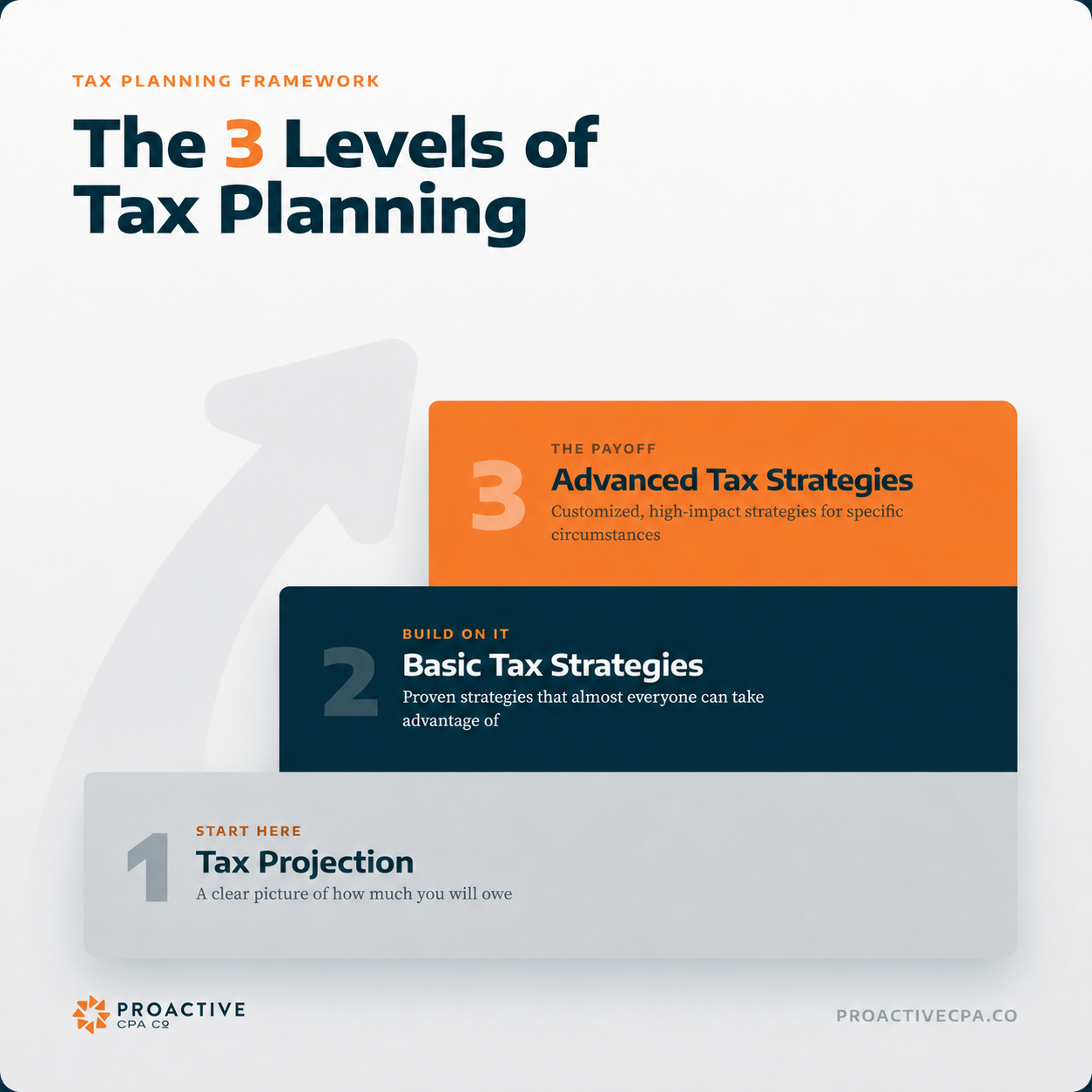
In a prior post I had talked about tax prep and tax planning and clarifying the differences between the two. However, even after someone is clear on the differences, I often still encounter a wide range of expectations as to what someone will receive from a tax plan. Over the years, I have boiled it down to three levels:
- Tax projections
- Basic tax strategies
- Advanced tax strategies
In this article, I want to explain what each level involves and help you determine which one is right for you.
Tax Planning Level 1: Tax Projection
In its simplest form, a tax projection is an estimate of how much you will owe in taxes.
It looks at what happened last year, what has happened so far this year, and what you expect to happen during the remainder of the year. It then uses that information to estimate your tax liability.
A projection is very black-and-white and matter-of-fact. It is not trying to increase or decrease your taxes. It is simply giving you the best estimate of what they will be.
If you have your taxes prepared professionally, your tax professional should provide an initial projection for the upcoming year. If your income or circumstances change during the year, contact them in late summer or early fall and ask them to update the projection.
As part of my annual process with clients, I provide a projection in the spring when we prepare the prior year’s tax returns. I then update it each time we meet throughout the year.
The biggest benefit of a projection is clarity. It helps you understand what you are likely to owe and gives you time to prepare. While receiving a large tax bill is never fun, knowing that it is coming several months in advance gives you time to save the money and avoid an unpleasant surprise.
Tax Planning Level 2: Basic Tax Strategies
Basic tax strategies are what I like to call the “low-hanging fruit” of tax savings.
These are strategies that apply to the broadest range of taxpayers, and the first step is to see which deductions and credits you can take. This includes items like taking the home-office deduction, contributing to a retirement plan, deducting mortgage interest, and claiming the child tax credit.
The goal here is to make sure you are checking all the appropriate boxes. While that may seem simple, there are so many deductions and credits available that it can be easy to overlook something that applies to you.
The next step of level 2 is to see if there are any opportunities for income shifting, expense shifting, or performing an entity analysis.
Income and expense shifting means evaluating the best year to recognize income or expenses in. For example, if a client needs to purchase a large piece of equipment and has flexibility, their tax professional can help them determine whether to purchase it this year or next year.
Entity analysis involves reviewing how your business is structured and determining whether that structure still makes sense for you. A business entity that was appropriate several years ago may no longer be the most tax-efficient choice as your company grows and changes.
A critical part of my client meetings is review what deductions and credits they can take, as well as look for opportunities for income or expense shifting, and evaluating their entity structure.
The biggest benefit of level 2 tax strategies is the peace of mind it provides you knowing you’re being proactive and getting out ahead of your taxes to minimize them; not anxiously waiting for April 15th to find out how much you owe.
Level 3: Advanced Tax Strategies
The final level involves advanced tax strategies. I call them advanced because they do not apply to every taxpayer. In fact, they do not apply to most taxpayers, and many people will never need them.
Advanced strategies are highly customized, and are often driven by a specific combination of income, business structure, industry, assets, and long-term goals. Strategies like cash balance plans, captive insurance, and IC-DISC are all examples of advanced tax strategies.
Although there are no universal income thresholds, these strategies are more common among higher-income individuals ($750K+) and larger businesses ($5MM+).
Advanced strategies often require coordination among multiple professionals, including a CPA, attorney, financial advisor, or other specialist. They often involve forming new legal entities, restructuring ownership, entering into formal agreements, or complying with additional reporting requirements. They may also require additional paperwork, ongoing administration, professional fees, and compliance obligations. It therefore takes a very specific set of circumstances, and a willingness to invest additional time and money, to make them worthwhile.
Because of this, while advanced strategies can create some of the largest tax savings, they also create the most complexities and should only be utilized after careful consideration with your team of advisors.
I am proud of the extensive network of professionals & specialists I’ve developed in the tax strategy world to help evaluate these strategies & bring them to my clients.
The benefit of level 3 strategies is that they produce the largest tax savings, and continue to provide peace of mind that you’re doing everything you can to take advantage of every tax law out there.
How the Three Levels Work Together
There are several important things to understand about these three levels.
First, all three are proactive activities. They happen during the tax year, before the tax return is filed. Once the year is over, most of your planning opportunities are gone. That is why tax planning requires communication with your tax professional throughout the year, not just at filing time.
Second, the levels build on one another like a staircase. Before implementing tax strategies, you need a reliable projection. Before considering advanced strategies, you should make sure the basic planning opportunities have already been addressed. You should not skip the foundational work before moving to a more advanced level.
Third, no level is “better” or “worse” then the other levels. You should be at the level that makes the most sense for your tax situation, financial goals, and comfort level. Some people do not need the complexity of advanced strategies. Others may decide they don’t want to spend the time looking for basic strategies. Both are perfectly reasonable positions.
Finally, even when moving up the levels, everyone moves through the levels at a different pace. One person may remain at Level 1 for several years before their situation calls for additional planning. Another may move from Level 1 to Level 2 within a few months. Someone else may spend years using basic strategies before an increase in income or business complexity makes advanced planning worthwhile. It is not a race.
The goal is not to reach Level 3. The goal is to be at the right level for your needs.
With this framework in mind, I hope you have a clearer understanding of how tax planning works and which level may be appropriate for you. If you would like to discuss your situation and determine which level of tax planning makes sense, please reach out.