No one ever wants to receive a surprise tax bill. Recently I asked a prospect what led them to reach out. They told me, “Last year my income jumped from $1MM to $3MM, but my tax pro didn’t catch it until they called me sheepishly the week of April 15th.”
While business owners are rarely surprised that taxes are due; they are often surprised by the size of the bill and how little time they have to pay it.
Here’s the encouraging part: none of this has to be a mystery. If you understand the 4 Main Reasons for a Surprise Tax Bill, and plan ahead during the year, then you’ll arrive at April 15th already knowing how much you owe. Here are four of the most common reasons business owners receive an unexpected tax bill—and what you can do today to address each one.
#1 – Your Business Makes More Money Than Expected
This is the best kind of tax problem to have, but it is still a problem if no one plans for it. While, it isn’t uncommon for most businesses to have fluctuating sales year to year, business owners & their team need to be tracking this throughout the year looking at budget vs actual, and comparing this year vs the prior. If you know in July that profit is running ahead of plan, you still have options. If you find out in April, all you have is a bill.
What to do today: Bring your bookkeeping current and prepare a full-year tax projection. Start with actual year-to-date results, then estimate revenue, payroll, subcontractor costs, equipment purchases, and other expenses for the remainder of the year.
#2 – Confusing Safe Harbor With Your Full Tax Bill
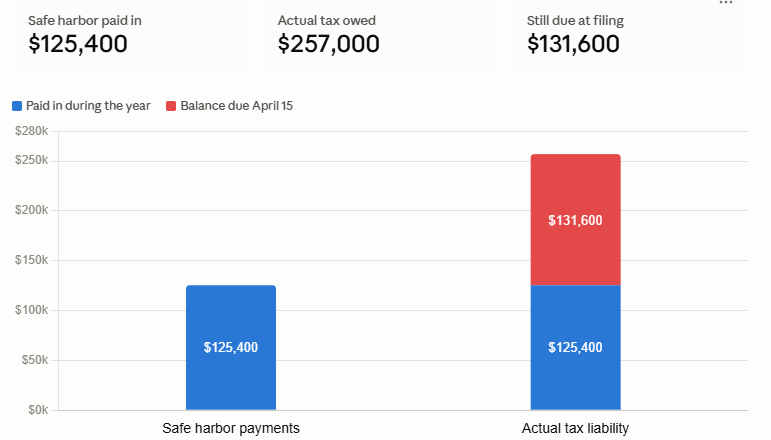
Unlike employees who have their taxes withheld from their paycheck, the IRS requires business owners to send in quarterly estimated payments. Safe harbor is the minimum you have to pay in to avoid an underpayment penalty. Under IRC §6654, you’re protected if you pay in the lesser of 90% of this year’s tax, or 110% of last year’s tax (100% if your prior-year AGI was less then $150,000). But safe harbor only addresses the penalty. It does not guarantee that you won’t owe more when you file.
For example, assume in the prior-year your taxable income was $500,000 and you had a tax liability of $114,000. That makes your applicable safe-harbor amount for this year $125,400 ($114K x 110%). If your taxable income this year is $900,000, then this year’s actual tax will be $257,000. Paying safe harbor of $125,400 may protect you from a federal underpayment penalties and interest, but it still leaves a $131,600 balance due.
These principles also are true for state income taxes, so be sure to factor those in as well.
What to do today: Make sure your CPA is calculating two numbers for you:
- Safe Harbor (i.e. Penalty protection): How much must you pay to satisfy the federal and applicable state safe-harbor rules & avoid penalties?
- Cash-flow Target: How much will you need to pay in to avoid a large balance when the returns are filed?
#3 – Did the Assumptions Behind Your Tax Projection Change?
A tax projection is based on assumptions. Often surprise bills arise when those assumptions change but the projection does not.
- A one-time gain occurred – Perhaps the business sold a fully depreciated excavator for $125,000. That cash may feel like the recovery of an old investment, but some or all of the proceeds may create taxable gain.
- A planned deduction disappeared – Maybe the company expected to purchase equipment, make a large retirement contribution, or qualify for a tax credit. If the purchase was delayed or the contribution was reduced, taxable income may be higher than projected.
- The business changed – Entering a new state, adding an owner, changing compensation, acquiring another company, or completing a major transaction can all alter the tax result. The consequences vary by transaction and by state.
What to do today: Review your last tax projection and the major assumptions behind it. Then identify what has changed. Contact your CPA before selling assets, making major purchases, changing ownership, or expanding into another state so they can advise you on the best way to handle each situation.
#4 – You Only Talk With Your Tax Professional at Tax Time
Tax preparation and tax planning are not the same service.
Tax preparation looks backward. Your CPA receives the completed numbers, prepares the returns, and calculates what happened.
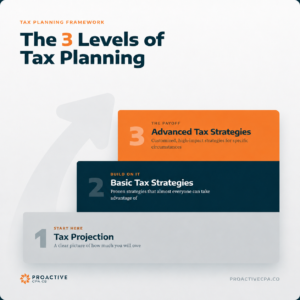
Tax planning looks forward. It projects what you will owe, reviews strategies to help you lower your bill, and gives you time to adjust estimated payments and cash flow before the year ends.
Far and away, only talking with your CPA when you’re filing your taxes is the most common mistake people make that leads to a surprise tax bill. Fortunately it is also the easiest to remedy.
What to do today: Get at least one planning meeting on the calendar before year-end. If you’re growing fast or things have gotten more complicated (e.g. sales are rapidly growing, operating in new states, adding new partners or employees, M&A activity, etc.), quarterly check-ins may be worth-while.
Summarizing Next Action Steps:
- Bring your financial statements up to date.
- Compare current results with the assumptions used in your last tax projection.
- Ask for both a safe-harbor calculation and a full-year tax projection.
- Schedule your next tax-planning meeting before tax season.
A surprise tax bill is often not a tax-return problem. It is a year-round planning problem.
A good CPA should do more than tell you what happened after the year is over. They should help you understand what is coming, evaluate your options, and prepare while there is still time to act. If you’d like to discuss your situation and get help avoiding a surprise tax bill, please reach out today!